


Fused Deposition Modelling or FDM 3D Printing Perth
The most common form of 3D printing.
FDM 3D Printing Services in Perth
Afaridan Plastics provides FDM (Fused Deposition Modelling) 3D printing services in Perth, manufacturing custom plastic components, functional prototypes, manufacturing aids, and short production runs.
FDM is a practical and often economical choice for larger components, design testing and applications where material performance matters more than a perfectly smooth surface finish.
Our team can assist with material selection, CAD design and manufacturing requirements, including assessing whether FDM, SLA, SLS or another process is best suited to your part.
What is Fused Deposition Modelling or FDM?
Fused Deposition Modelling or FDM 3D printing is a method of additive manufacturing in which a thermoplastic (plastic which can be reformed when heated) is melted and fused together layer by layer. The plastic is then allowed to cool to form a solid object. Fused Deposition Modelling (FDM) is sometimes also referred to as Fused Filament Fabrication (FFF).
This process is achieved by heating up a component aptly named the heat block, located within the hotend. This component is made of a material which can transfer heat well such as aluminium or copper. The thermoplastic chosen is then fed into the heat block where it is melted and extruded out through a nozzle.
The nozzle is constantly being moved based on instructions that take the form of gcode like that used to control similar computer numerical control (CNC) devices such as CNC mills. The gcode is generated from the slicer software and is based on the 3D model, supports, and infill settings.

FDM 3D Printed part showng the affect of layer lines.

Large FDM part with clear layers and regular extrusion.

FDM 3D Printed part with internal geometry.
FDM 3D Printed part showng the affect of layer lines.
When we use Fused Deposition Modelling (FDM)
Fused deposition modelling is suitable for a number of applications such as prototyping, small runs of plastic parts and one off parts. Due to the nature of FDM, the larger the part the longer it takes to print. The costs associated with FDM do not scale well when considering thousands of parts. In these cases injection moulding would be both faster and cheaper despite the initial investment in tooling that is required.
Selective Laser Sintering (SLS) and Stereolithography (SLA) are both alternative 3D printing methods which have pros and cons compared to FDM. SLS uses powder that is sintered so generally produces the highest strength parts. Meanwhile SLA uses resin to create high-end prints with the best surface finish or "smoothness".
FDM, on the other hand, is generally more affordable compared to other 3D printing processes. However, FDM is less suited to industrial 3D printing due to worse mechanical properties than other technologies and the risk of layer splitting.
Feel free to contact us if you would like to discuss what manufacturing process would suit your part.

FDM Materials
A large variety of materials can be printed using Fused Deposition Modelling. This includes but is not limited to PLA, ABS, ASA, TPU, PETG, PEEK, and Nylon. Some materials require machines with specific setups. Due to the low melting temperature and overall accessibility, Polylactic Acid (PLA) is the most common material to be used in traditional fused deposition 3D printers.
Polyethylene Terephthalate Glycol (PETG) is also very common as it is still reasonably easy to print and can withstand higher temperatures than PLA.
Many of the materials also come in a wide variety of colours allowing for a final product that doesn't need to be painted. Learn more about all the 3D printing processes used at Afaridan.
PLA
Easy to print and dimensionally stable. Suitable for visual prototypes, models and basic fit checks. Limited heat resistance.
PETG
Tough, with good general chemical resistance. Useful for housings, brackets and functional prototypes.
ABS
Good toughness and heat resistance compared with PLA. Commonly used for functional plastic components.
ASA
Similar to ABS, with improved UV and weather resistance. Often preferred for outdoor applications.
TPU
Flexible and abrasion-resistant. Used for grips, protective covers, pads and compliant components.
Nylon
Tough and wear-resistant, with properties dependent on the specific grade. Suitable for selected mechanical components.
Specialist materials such as polycarbonate, carbon-fibre-filled polymers and PEEK are also used in industrial FDM printing, but require suitable high-temperature equipment and processing conditions. Not all materials are available on every printer. Afaridan commonly provides feedback on suitable material and manufacturing options based on the intended application.

Multi-Material FDM 3D Printing
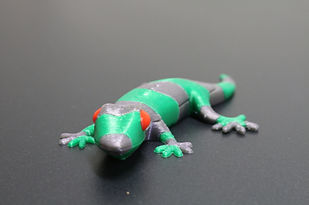
Some FDM systems can print with multiple filaments within the same build. This can be useful for combining colours, producing identification features or using a separate support material. Soluble or breakaway support materials can also make certain complex geometries easier to manufacture and reduce the need for manual support removal.
Multi-material printing is not suitable for every design. Compatibility between materials, bonding and additional printing time need to be considered.


Afaridan's FDM 3D Printing Perth
Based in Malaga, Western Australia, Afaridan manufactures custom 3D printed components for local and Australia-wide customers. Our team can work from existing CAD files or assist with 3D scanning, reverse engineering and design modifications where a printable model is not available.
Before manufacturing, we consider the component's intended use, material requirements, critical dimensions, quantity and whether the design is practical to produce using FDM.
If you have a component requiring 3D printing, send us your 3D model or project requirements. We can review the part and recommend a suitable material and manufacturing process.