


Selective Laser Sintering or SLS 3D Printing Perth
SLS 3D Printing Services in Perth
Afaridan Plastics' Perth SLS 3D printing services provide high strength prototypes and production parts for organisations nationwide. Using Selective Laser Sintering (SLS), we manufacture durable nylon components with complex geometries and excellent mechanical performance.
Based in Malaga, Perth, Afaridan Plastics is one of the largest SLS 3D printing service providers in Australia. Our team offers fast turnaround times, local engineering support, and reliable quality. Whether you need functional prototypes or end use parts, our SLS process delivers reliable results suitable for demanding industrial applications.
SLS 3D printing is ideal for industries that require strength, design freedom, and outside 3D prints. Our local production capability allows us to support projects from early stage prototyping through to manufacturing, all within Western Australia.
If you’re looking for industrial SLS 3D printing in Perth, our team can help you select the right materials, optimise your designs for SLS, and deliver high quality parts with a quick turn around time.

Afaridan Plastics is investing in even larger SLS 3D printing capabilities. This will be one of a kind in Perth, and will increase our available SLS throughput. The build volume of our new industrial SLS printer will be 330 × 330 × 565 mm.


What is Selective Laser Sintering?
Selective Laser Sintering (SLS) is a form of powder bed fusion 3D printing which uses a laser to sinter layers of powder. After a layer is sintered together, the powder bed moves down to allow a new layer of powder to be spread over the top. The process continues sintering new layers to the previous layer until the part is completed.
Selective Laser Sintering parts are characterised by their isotropic strength, UV resistance, and lack of supports required. SLS 3D printing can be used for both prototyping and batch production.
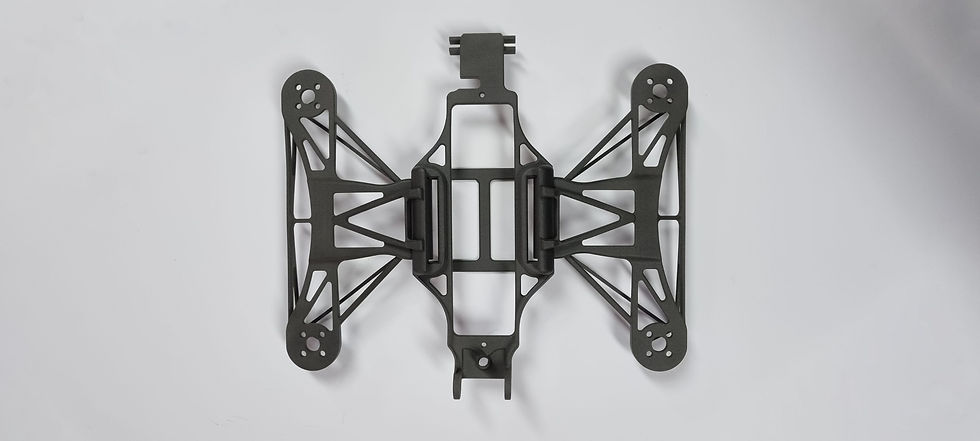
Here are some examples of SLS 3D printed parts:


When to use Selective Laser Sintering
Due to the ability to stack many parts in one build chamber, Selective Laser Sintering can often achieve faster printing rates than SLA or FDM. SLS should be considered when you need very strong prototypes or end use production parts.
Selective Laser Sintering provides strong, UV resistant parts which can be used in demanding end-use applications where we might not recommend other 3D printing technologies like FDM or SLA 3D printing.
SLS 3D printing is used in Perth and across Australia in industrial applications such as manufacturing, engineering, aerospace, defence, agriculture, and a range of other industries.

SLS Materials
Selective Laser Sintering primarily uses engineering grade polymers. Most parts are printed using Nylon 12 but other materials such as Nylon 11 and TPU are also available upon request. SLS 3D printing materials are generally grey in colour, however there are some other options available.
Nylon 12, which is usually grey, can also be dyed to darker colours such as a dark red, green, or even blue. If bright colours are required, it is possible to print using a white Nylon 12 and dye to a light colour.
Painting can also be an option for SLS 3D printing depending on the durability required.
Most customers are happy with standard Nylon 12 due to its strength and other properties, but our team is more than happy to discuss your next SLS printing project.

What About Selective Laser Melting or SLM?
Selective Laser Melting (SLM) is another process that comes under the powder bed fusion category. The process is remarkably similar to SLS. Instead of using a polymer or plastic, the powder used for SLM is metal. The laser is used to melt the metal powder in each layer to form a complete part.
At Afaridan Plastics, we provide Selective Laser Sintering (SLS) 3D printing services in house and can work with trusted SLM 3D printing partners when required.
We find that SLS 3D printing is more than capable for most projects, including prototyping and end use parts. Our parent company, Adarsh Australia, can also produce parts with CNC machining or casting depending on the geometry. This means there is limited need to invest in expensive (or poor quality) metal 3D printing.
Industries We Serve With SLS
SLS 3D printing is widely used in Perth and across Australia for demanding industrial additive manufacturing where strength, accuracy, and reliability are critical. Our SLS technology enables the production of complex, performance parts that meet the requirements of a broad range of industries.
We regularly support organisations in:
-
Manufacturing: Functional prototypes, production parts, jigs, fixtures, and tooling components.
-
Engineering and product development: Rapid iteration of functional designs without the constraints of traditional manufacturing. Durable components for mechanical assemblies, testing, and validation, with excellent performance.
-
Aerospace: Lightweight, functional components with complex geometries. Suitable for prototyping and end use applications such as drones and UAVs.
-
Defence: Robust parts for testing, fixtures, housings, and complex components where precision matters.
-
Mining & Resources: Custom brackets, enclosures, and replacement parts to withstand harsh operating environments.
Because our SLS 3D printing is done in Perth, we can support projects locally while servicing customers across Western Australia and Australia wide. From one off prototypes to short production runs, SLS offers the flexibility and performance required by industry.




Request a Quote for SLS 3D Printing
Contact our team to request a quote for SLS 3D printing services. Our engineers work closely with you to understand your application, performance requirements, and timelines to ensure the best possible solution.
With local Perth production, we offer fast turnaround times, clear communication, and dependable quality for customers across WA and Australia. Whether you need a single prototype or a production run, we can provide a quote tailored to your project.
To get started, provide details such as material preferences, quantities, and intended use case. Our engineers will review your design or idea, assess suitability for SLS manufacturing, and recommend any optimisations to improve strength, finish, or cost efficiency.